
Last updated: 21 November 2026
No print run is identical to the screen or to the last run. These are the tolerances we hold every order to. A result inside them is accepted print; a result outside them qualifies for a reprint.
Flat printed items
Applies to single loose-sheet products: name cards, flyers, postcards, stickers on sheet, cards and similar.
- Colour vs. intended colour: accepted within 10%, checked against our CMYK Colour Reference Book. More than 10% qualifies for a reprint.
- Colour between pieces in one run, or between repeat runs: accepted within 10%. More than 10% qualifies for a reprint.
- Trim position, offset printing: accepted up to 1mm. More than 1mm qualifies for a reprint.
- Trim position, digital printing: accepted up to 2mm. More than 2mm qualifies for a reprint.
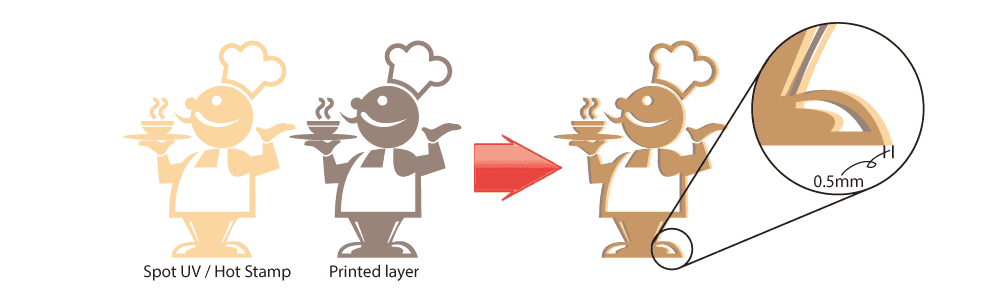
- Spot UV, hot stamping, die-cut and embossing position: accepted up to 0.5mm. More than 0.5mm qualifies for a reprint.
- Dirty spots: one spot of 0.5mm or less within any 5cm² is accepted. Two or more spots within 5cm², or any spot over 0.5mm, qualifies for a reprint.
- Lamination bubbles: bubbles of 1mm or less are accepted. Any bubble over 1mm qualifies for a reprint.
What the tolerances look like
Colour discrepancy — within 10% of the intended colour is accepted.
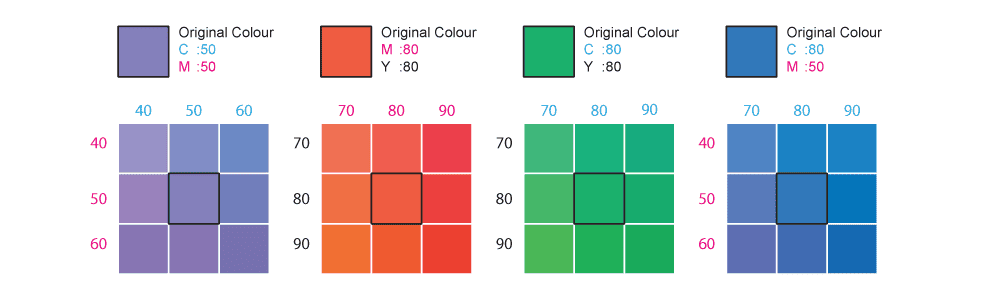
Colour variance within a batch — up to 10% between pieces in the same run is accepted.

Spot UV, hot stamping, die-cut and embossing position — up to 0.5mm is accepted.
Dirty spots — one spot of 0.5mm or less within any 5cm² is accepted.

Lamination bubbles — bubbles of 1mm or less are accepted.

Why colour varies between screen, paper, machines and repeat orders is explained in our guide Why does my print colour look different?
Large format, sublimation and bound products
Banners, posters, rollup stands, fabric, sublimated items, booklets and other collated products are judged on whether the item is fit for its normal use and matches the specifications ordered. Colour on these is matched as closely as the material allows, not to the 10% standard above.
What is not a print defect
- Colour that differs from your screen, a previous print by another printer, or an RGB file. Screens and ink use different colour systems. See Why does my print colour look different?
- Problems from the file supplied: spelling, low-resolution images, missing bleed (3mm required), fonts not outlined, wrong size or layout.
- Options you selected at checkout, such as paper, finish or quantity.
- White edges or cracking on folds of heavy stock or dark ink coverage, which are normal for the material.
- Minor differences in material texture or tone between batches from the mill.
To report a problem, see our Reprint, Return & Refund Policy.


